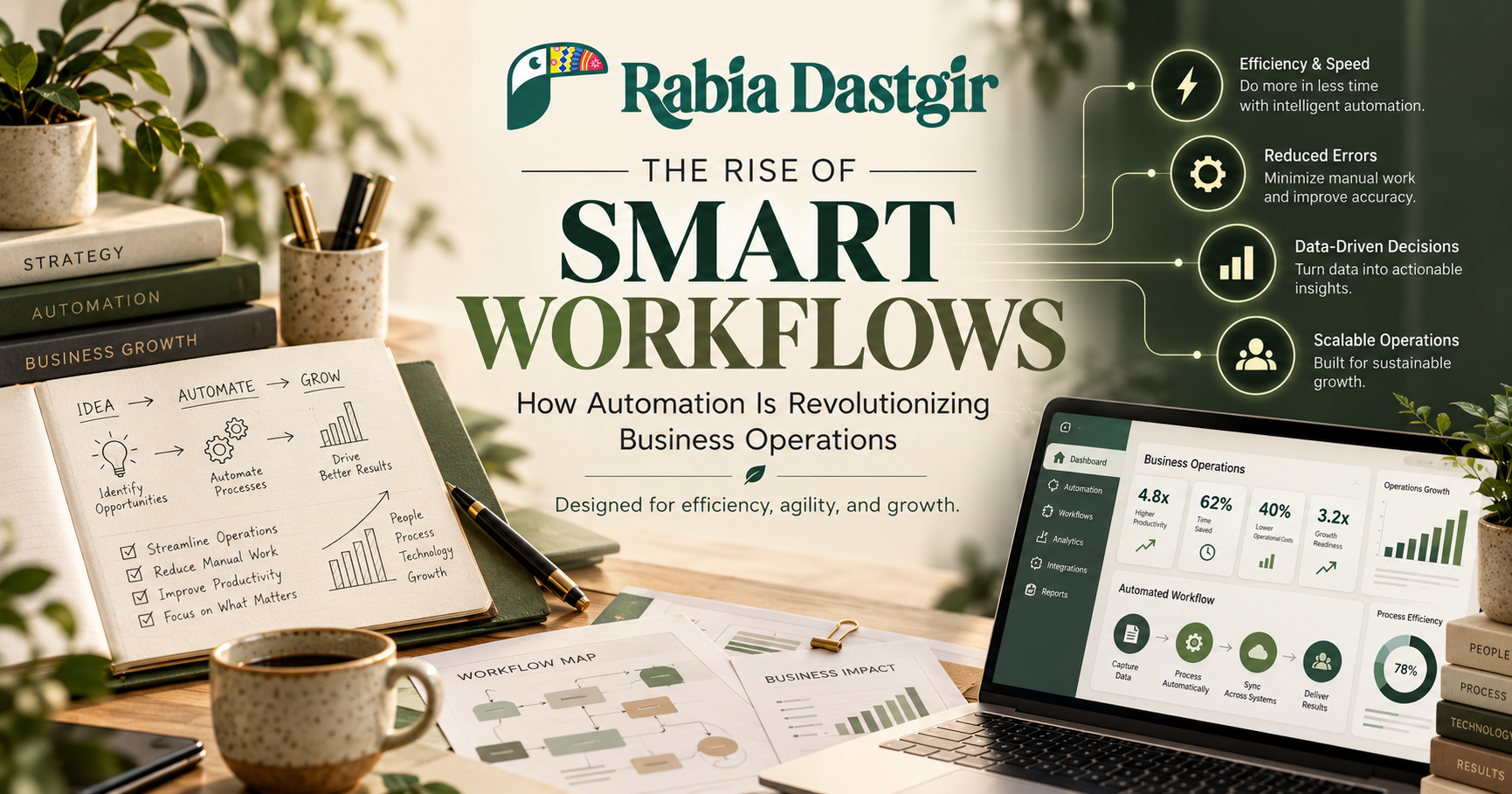
The Rise of Smart Workflows: How Automation Is Revolutionizing Business Operations
Introduction
In today’s fast-moving business environment, time, efficiency, and adaptability have become critical competitive advantages. Organizations can no longer afford to spend valuable hours on repetitive manual tasks, disconnected systems, unnecessary approvals, and inefficient processes.
This is where smart workflows and business automation are transforming the way modern companies operate.
Automation is no longer limited to manufacturing lines or physical machinery. Today, workflow automation connects people, data, software, artificial intelligence, and digital platforms to streamline everyday business operations.
From invoice processing and customer support to marketing, inventory management, reporting, forecasting, and creative production, automated workflows are helping organizations work faster, reduce errors, and make better-informed decisions.
This transformation is also closely connected to the wider shift toward digital transformation in business and design, where companies are rethinking not only the tools they use but the way their entire operations are structured.
Rather than replacing human talent, smart automation allows employees to spend less time managing routine processes and more time focusing on strategy, creativity, innovation, and customer relationships.
At Rabia Dastgir Design Consultants (RDDC), we believe the future of business lies in creating intelligent systems where technology supports human capability. Businesses that adopt smarter workflows today can build more efficient, scalable, and resilient operations for tomorrow.
What Are Smart Workflows?
A smart workflow is a structured business process that uses automation, software integrations, artificial intelligence, predefined rules, or data-driven decision-making to complete tasks with minimal unnecessary manual intervention.
Traditional workflows frequently require employees to manually transfer information between systems, send reminders, update spreadsheets, create reports, or check whether tasks have been completed.
Smart workflows allow many of these actions to happen automatically.
For example, when a potential customer completes an online enquiry form, a smart workflow could automatically:
- Add the lead to the company CRM.
- Categorize the enquiry.
- Assign the relevant employee.
- Send the customer a confirmation email.
- Create a follow-up task.
- Update the sales pipeline.
- Add the interaction to a reporting dashboard.
What previously required several manual actions can happen within seconds.
IBM describes business automation as using automation solutions to manage repetitive tasks and streamline workflows, allowing employees to focus on higher-value activities. IBM: What Is Business Automation?
The combination of automation, AI, system integration, data, and strategic workflow design is therefore becoming an increasingly important part of modern business operations.
Why Smart Workflows Matter for Modern Businesses
As businesses grow, operations naturally become more complex.
More customers usually mean more communication. More products create additional inventory requirements. More employees increase internal coordination. More platforms produce more data.
Without efficient systems, growth can actually create operational bottlenecks.
This is why businesses increasingly need to think about automation as part of a broader business advisory and strategy approach rather than treating it as an isolated technology project.
1. Increasing Operational Complexity
Growing businesses often operate across multiple departments, locations, suppliers, software platforms, and customer segments.
Managing these processes manually can create:
- Communication gaps
- Duplicate tasks
- Slow approvals
- Data inconsistencies
- Missed deadlines
- Reporting delays
- Operational bottlenecks
Automated workflows connect systems and departments so information can move throughout an organization with less manual intervention.
Instead of employees repeatedly checking whether the next step has been completed, workflows can automatically trigger the correct action.
2. Rising Customer Expectations
Modern customers expect businesses to be responsive.
Whether they are booking an appointment, purchasing a product, requesting information, or contacting customer support, they expect a smooth experience.
Smart workflow automation can help businesses manage:
- Customer enquiries
- Appointment confirmations
- Email follow-ups
- Order notifications
- Customer onboarding
- Support requests
- Lead nurturing
- Personalized communication
Automation helps companies provide faster responses while creating more consistent customer experiences.
3. Greater Need for Cost Efficiency
Businesses across industries are under pressure to improve productivity without continuously increasing operating costs.
Automation can help organizations manage growth more efficiently.
Instead of increasing administrative workload every time the business grows, companies can automate specific repetitive activities and allow employees to focus on responsibilities where human expertise creates greater value.
4. Managing Data Overload
Businesses now generate enormous quantities of information through:
- Websites
- CRM platforms
- Analytics systems
- Advertising platforms
- Accounting software
- Ecommerce systems
- Social media
- Supply chains
- Customer interactions
Manually processing all this information is increasingly unrealistic.
Smart workflows can automatically collect, organize, analyse, and distribute information.
This becomes even more powerful when automation is combined with predictive analytics and data-driven decision-making.
Instead of spending hours preparing reports, decision-makers can access structured insights that help them respond to changes faster.
Applications of Smart Workflows in Business
Automation can be introduced across almost every department of an organization.
The most effective strategy, however, is not to automate everything. Businesses should identify repetitive, time-consuming, and scalable processes where automation can create meaningful value.
1. Robotic Process Automation (RPA)
Robotic Process Automation, or RPA, uses software robots to complete repetitive, rule-based digital tasks.
According to UiPath, RPA software robots can handle activities such as entering data, moving files, and processing transactions across digital systems. UiPath: What Is Robotic Process Automation?
Common applications include:
- Data entry
- Invoice processing
- Report generation
- Document verification
- Transaction reconciliation
- Database updates
- Compliance checks
- Information transfers between systems
Finance departments, for example, can use RPA to process large numbers of transactions without requiring employees to manually copy information between multiple platforms.
RPA works particularly well when the process is repetitive, predictable, and governed by clearly defined rules.
2. AI-Powered Scheduling and Customer Support
Artificial intelligence is increasingly becoming part of everyday administrative and customer service workflows.
AI-powered systems can help automate:
- Appointment scheduling
- Calendar management
- Basic customer support
- FAQ responses
- Lead qualification
- Follow-up communication
- Internal task assignment
A customer could submit an enquiry outside normal working hours and immediately receive relevant information while the enquiry is simultaneously categorized and assigned to the appropriate employee.
Human representatives can then focus on situations that require judgment, empathy, negotiation, or specialist knowledge.
The goal is not to remove human interaction.
It is to use automation where human intervention adds little value and preserve human attention for areas where it matters most.
3. Supply Chain and Inventory Automation
Supply chains involve a complex network of suppliers, manufacturers, transportation providers, warehouses, retailers, and customers.
Manual management becomes increasingly difficult as the number of products and locations increases.
Smart inventory workflows can monitor stock levels in real time and automatically trigger actions when inventory reaches predetermined thresholds.
Businesses can use automation to:
- Track shipments
- Manage warehouse inventory
- Identify potential shortages
- Generate purchase requests
- Coordinate suppliers
- Predict stock requirements
- Monitor delivery performance
Supply chain automation can also strengthen transparency.
As discussed in RDDC’s article on why supply chain visibility is becoming increasingly important, consumers and business leaders increasingly want to understand where products come from and how they move through the supply chain.
Better data systems make this visibility easier to achieve.
4. Marketing Automation
Modern marketing teams manage numerous platforms, campaigns, audiences, creative assets, and customer journeys simultaneously.
Marketing automation allows these processes to become more structured.
Imagine someone downloading a resource from a company’s website.
An automated workflow could:
- Add the contact to the CRM.
- Categorize the user according to interest.
- Trigger a relevant email sequence.
- Assign a lead score.
- Track further website activity.
- Notify the sales team when the lead reaches a predefined stage.
Marketing automation can support:
- Email campaigns
- Lead nurturing
- Customer segmentation
- CRM management
- Campaign reporting
- Customer re-engagement
- Personalization
- Sales handovers
The result is a more connected journey from initial awareness to enquiry and conversion.
5. Sales Workflow Automation
Sales professionals often spend a surprising amount of their working day completing administrative work.
CRM updates, reminders, follow-ups, lead assignments, meeting scheduling, and reporting can consume time that could otherwise be spent speaking with customers.
Smart sales workflows can automate activities such as:
- Capturing incoming leads
- Assigning leads to sales representatives
- Creating follow-up reminders
- Updating CRM stages
- Sending predefined communications
- Monitoring pipeline movement
- Generating sales reports
This creates a more organized sales process while helping reduce the risk of opportunities being forgotten.
6. Automated Reporting and Business Intelligence
Reporting is another area where automation can create substantial efficiencies.
Traditional reporting frequently involves manually exporting information from multiple platforms, transferring it into spreadsheets, cleaning the data, and producing presentations.
Smart reporting workflows can connect those systems directly.
Businesses can automatically monitor:
- Revenue
- Marketing performance
- Customer acquisition
- Sales pipelines
- Inventory
- Operational performance
- Financial metrics
- Customer behaviour
Combining workflow automation with predictive analytics can transform reporting from a retrospective process into a more forward-looking business tool.
Rather than simply asking, “What happened?”, businesses can begin asking, “What is likely to happen next?”
For a deeper look at this shift, explore RDDC’s guide to turning data into decisions through predictive analytics.
Automation in Creative Industries
Automation is not limited to finance, logistics, or technology companies.
It is also becoming increasingly relevant across fashion, design, branding, retail, and other creative industries.
However, creative automation does not necessarily mean automating creativity itself.
Instead, technology can handle the repetitive processes surrounding creative work.
Examples include:
- Automated file organization
- Digital asset management
- Design version control
- AI-assisted ideation
- Automated reporting
- Production tracking
- Inventory management
- Client approval systems
- Manufacturing workflows
This allows designers and creative teams to spend more time developing ideas rather than managing administrative processes.
The fashion industry provides an especially strong example.
RDDC has explored how AI is influencing fashion design and how slow fashion can coexist with fast innovation.
These developments demonstrate an important point:
Technology and creativity do not have to compete.
When implemented strategically, technology can create more room for creativity.
The Business Benefits of Automation
The value of workflow automation extends well beyond simply completing tasks faster.
Increased Efficiency and Speed
One of the most immediate benefits of automation is speed.
Processes that previously required hours or days can sometimes be completed within minutes.
Information can move automatically between systems without waiting for employees to manually transfer it.
Microsoft describes business process automation as using software to manage routine workflows faster, more accurately, and more consistently, allowing teams to focus on higher-value work. Microsoft: Business Process Automation Benefits
This efficiency allows organizations to increase output without necessarily increasing administrative resources at the same rate.
Reduced Human Error
Humans are naturally more likely to make mistakes when performing the same repetitive activity hundreds of times.
Common examples include:
- Incorrect data entry
- Duplicate records
- Missed follow-ups
- Incorrect calculations
- Forgotten approvals
- Inconsistent documentation
Automated workflows execute predefined processes consistently.
Automation does not eliminate the need for monitoring or quality control, but it can significantly reduce errors associated with repetitive manual work.
Better Employee Productivity
The most valuable contributions employees make usually involve:
- Judgment
- Creativity
- Communication
- Strategy
- Leadership
- Problem-solving
- Relationship building
Copying information between spreadsheets rarely makes the best use of those skills.
Automation allows employees to spend less time completing routine administrative tasks and more time working on responsibilities where human intelligence creates greater value.
Lower Operational Costs
Automation can also help companies improve cost efficiency.
By reducing unnecessary administrative effort, organizations can process larger workloads without automatically needing equivalent increases in staffing or operational expenditure.
This does not necessarily mean reducing teams.
It can instead mean using existing resources more effectively.
Improved Business Agility
Customer behaviour changes.
Supply chains experience disruption.
New competitors enter markets.
Technology evolves.
Regulations change.
Businesses must be able to adapt.
Automated systems make it easier to adjust processes, workflows, and decision-making structures as circumstances change.
This is particularly important during periods of uncertainty, where business consultation during disruption can help organizations rethink how they operate.
Greater Visibility and Accountability
Smart workflows also make operations easier to understand.
Businesses can see:
- Who owns each task
- Which actions have been completed
- Where delays occur
- How long processes take
- Which activities create bottlenecks
- Where customers leave a journey
This visibility helps managers identify problems before they become larger operational issues.
Case Example: Automation in Fashion Retail
Consider a fashion retailer managing thousands of stock-keeping units across multiple stores, warehouses, and regions.
Traditionally, employees may need to:
- Review sales data
- Track inventory
- Update spreadsheets
- Contact suppliers
- Request stock transfers
- Identify shortages
- Create purchase orders
As the retailer grows, these processes become increasingly difficult to manage manually.
One location could hold excess inventory while another repeatedly experiences shortages.
Smart workflow automation provides a different model.
Real-Time Inventory Updates
Every sale automatically updates inventory records across stores, warehouses, and ecommerce systems.
Management receives an accurate view of product availability without depending entirely on manual reports.
Automated Reordering
When stock reaches a predetermined threshold, the system can automatically generate a purchase request or notify the appropriate purchasing team.
Popular products are therefore less likely to become unavailable simply because somebody forgot to place an order.
AI-Driven Demand Forecasting
Historical sales data can be combined with:
- Seasonal trends
- Regional preferences
- Promotions
- Buying behaviour
- Product performance
This information can help businesses forecast future demand and distribute inventory more intelligently.
Automated Stock Transfers
If one store has excess inventory while another experiences unusually high demand, an intelligent inventory system can highlight the imbalance and recommend a transfer.
The result can include:
- Reduced inventory waste
- Better product availability
- More efficient purchasing
- Improved customer experience
- Leaner supply chains
Automation can therefore contribute not only to profitability but also to sustainability.
Reducing overproduction and unnecessary inventory aligns closely with the principles discussed in RDDC’s analysis of the economics of sustainability in fashion and the future of circular fashion strategy.
How to Implement Smart Workflows Successfully
One of the biggest mistakes businesses can make is beginning with software.
Automation should begin with the process.
Automating an inefficient workflow simply allows an inefficient process to operate faster.
A successful automation strategy therefore requires several stages.
1. Identify Repetitive Processes
Start by examining activities employees complete regularly.
Look for processes involving:
- Repetitive data entry
- Manual reporting
- Repeated customer communication
- Routine approvals
- File transfers
- Scheduling
- System updates
- Administrative tasks
These processes often provide the clearest opportunities for automation.
2. Map the Existing Workflow
Before changing a process, understand how it currently works.
Identify:
- Who performs each task
- Which systems are involved
- Where information originates
- Where approvals occur
- Where delays happen
- Which steps are duplicated
- Where errors typically occur
Workflow mapping allows the organization to identify the actual problem before choosing a solution.
3. Remove Unnecessary Steps
Not every existing task should be automated.
Some should simply disappear.
Before implementing new technology, businesses should identify:
- Duplicate approvals
- Outdated reporting requirements
- Unnecessary data entry
- Repeated communication
- Inefficient handovers
Good automation starts with simplification.
4. Connect Existing Systems
Many businesses already own powerful technology.
The problem is that those platforms frequently operate independently.
CRM systems, accounting platforms, project management software, websites, marketing tools, and analytics systems may all contain different pieces of the same customer journey.
Integrating these systems creates a more connected operational environment.
Microsoft’s Power Automate, for example, is designed around connecting and automating business processes across applications and systems. Microsoft Power Automate
5. Measure Performance
Automation should not be treated as a one-time project.
Businesses should monitor whether new workflows actually improve performance.
Useful metrics may include:
- Processing time
- Cost per task
- Error rate
- Customer response time
- Conversion rate
- Employee productivity
- Customer satisfaction
- Number of manual interventions
Performance data can then guide further improvements.
RDDC’s Approach to Smart Workflow Design
At Rabia Dastgir Design Consultants, we approach automation from a strategic perspective.
Technology alone does not create operational excellence.
Successful automation requires understanding how people, processes, technology, business objectives, and customer experiences work together.
This philosophy reflects our wider approach to business advisory and strategy, where solutions are built around long-term organizational objectives rather than individual tools.
Workflow Mapping and Gap Analysis
The process begins by understanding how your organization currently operates.
This may include examining:
- Workflows
- Responsibilities
- Communication channels
- Software platforms
- Approval processes
- Reporting structures
- Customer journeys
- Operational bottlenecks
Mapping the existing system reveals where unnecessary manual work, duplication, or delays exist.
Technology Integration
Many businesses already use several platforms but fail to connect them effectively.
The objective should not necessarily be to replace everything.
Instead, existing systems can often be integrated more effectively.
These may include:
- CRM platforms
- ERP systems
- Marketing tools
- Project management software
- Accounting platforms
- Reporting dashboards
- Automation systems
- AI-powered tools
Connecting these platforms allows information to flow more naturally through the organization.
Customized Workflow Solutions
There is no universal automation strategy.
A solution designed for a multinational retailer may be completely inappropriate for a small creative agency.
A fashion company may prioritize sourcing, inventory, production, and supplier workflows.
A professional services business may prioritize lead management, client onboarding, project management, and reporting.
RDDC therefore designs workflows around each organization’s:
- Business model
- Team structure
- Existing technology
- Industry
- Growth objectives
- Customer journey
Employee Training and Change Management
One of the most overlooked elements of automation is people.
Even the most sophisticated workflow can fail if employees do not understand why it exists or how to use it.
Change management should therefore be part of automation strategy from the beginning.
Employees need to understand:
- What is changing
- Why it is changing
- Which tasks will become automated
- Where human decisions are still required
- How the new workflow benefits their work
The strongest automation strategies help employees perform better rather than simply introducing more technology into their working day.
Scalability and Future-Proofing
Businesses evolve.
Teams grow.
Customer expectations change.
Platforms are replaced.
New markets emerge.
Smart workflows should therefore be designed to scale.
At RDDC, the objective is not simply to solve today’s bottleneck but to develop operational systems capable of supporting tomorrow’s growth.
Businesses considering broader strategic transformation can also explore how expert consultancy can accelerate brand growth.
The Future of Workflow Automation
The next phase of automation will extend beyond isolated automated tasks.
Businesses are moving toward connected systems capable of coordinating entire workflows across departments.
Hyperautomation
Hyperautomation involves combining multiple technologies to automate more complete business processes.
These technologies can include:
- Artificial intelligence
- Machine learning
- RPA
- Workflow automation
- Process mining
- Analytics
- System integrations
Instead of automating one individual action, businesses can automate complete operational journeys.
AI Agents and Intelligent Workflows
Artificial intelligence is also moving beyond simply generating information.
Increasingly capable AI systems can help:
- Gather information
- Analyse data
- Recommend actions
- Coordinate software
- Trigger processes
- Assist employees with decisions
The likely future is not a business operated entirely by machines.
It is a business where people supervise increasingly intelligent systems.
Human + Machine Collaboration
The most effective organizations will understand what humans and machines each do well.
Automation excels at:
- Repetition
- Speed
- Data processing
- Pattern recognition
- Consistency
Humans remain especially valuable for:
- Judgment
- Creativity
- Empathy
- Leadership
- Negotiation
- Strategic thinking
The future of work will increasingly involve designing workflows that bring these strengths together.
Predictive Automation
Traditional automation responds after something happens.
Predictive automation attempts to act before the problem occurs.
Future workflows may identify:
- When inventory is likely to run out
- Which customers may require support
- Which leads are most likely to convert
- When equipment may fail
- Where operational delays are developing
- Which products may experience increased demand
This convergence between predictive analytics and workflow automation could fundamentally change how organizations make decisions.
Sustainable Automation
Automation will also become increasingly important to sustainability.
Smart systems can help businesses:
- Reduce overproduction
- Optimize transportation
- Monitor energy consumption
- Improve material utilization
- Reduce inventory waste
- Strengthen supply chain visibility
For fashion and product businesses in particular, this connects automation directly with sustainable apparel design and circular fashion strategies.
Technology can therefore support both operational efficiency and more responsible resource use.
Smart Workflows Are Changing the Future of Business
The rise of smart workflows represents an important shift in how organizations operate.
Businesses no longer need employees to manually manage every repetitive administrative process.
Through business automation, AI, RPA, predictive analytics, integrations, and intelligent workflow design, companies can create operations that are:
- Faster
- More accurate
- More scalable
- More transparent
- More responsive
- Easier to measure
However, successful automation is not about introducing technology everywhere.
It is about identifying the areas where technology can create meaningful improvement while allowing people to focus on activities requiring human intelligence, creativity, expertise, and judgment.
Automation is not the end of human work. It is the evolution of how work gets done.
Design Smarter Business Workflows with RDDC
At Rabia Dastgir Design Consultants, we help businesses identify inefficiencies, redesign processes, connect technology, and develop smart workflows aligned with real business objectives.
Whether your organization operates in fashion, retail, professional services, creative industries, or another growing sector, an effective automation strategy can help reduce operational friction, improve productivity, and create a stronger foundation for sustainable growth.
Rather than simply adding more software, our focus is on designing systems that work together.
Explore our business advisory and strategy services to learn how RDDC can help strengthen your wider business strategy, or start a project with RDDC to discuss your organization’s requirements.
Ready to transform the way your business operates?
Partner with Rabia Dastgir Design Consultants to design smarter workflows, automate repetitive processes, and build a more efficient and scalable business.